> ## Documentation Index
> Fetch the complete documentation index at: https://blog.elevate.do/llms.txt
> Use this file to discover all available pages before exploring further.
# Clankers: When Star Wars Slang Meets AI Anxiety
> Written by Rahul Parundekar. Published on 10th September, 2025.
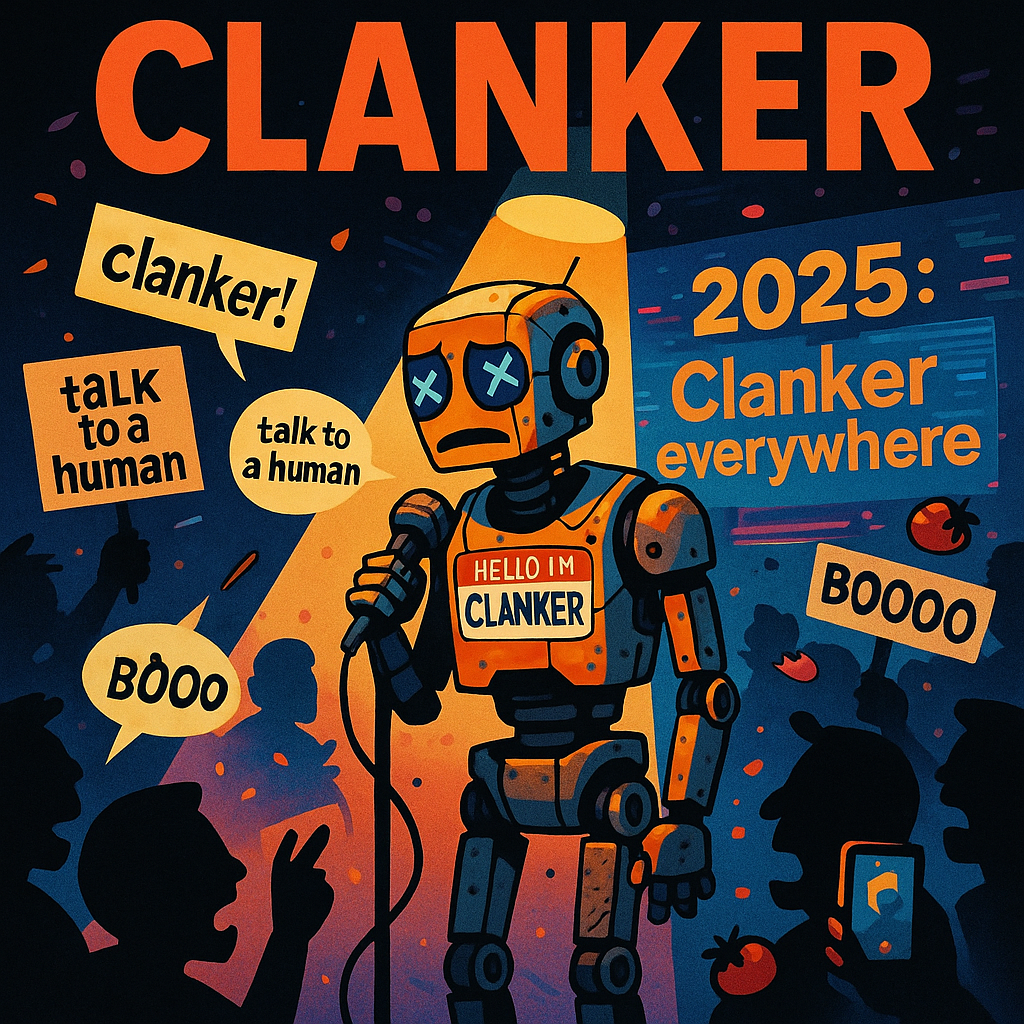 > Image generated using GPT-5 on September 10th, 2025.
I was watching Ludwig's [stream](https://www.youtube.com/@ludwig) the the other day when he made a comment that got me tickled: "Let's ask the Clanker." He was talking about asking the question to ChatGPT, but the word choice hit different. Since when did clone trooper trash talk become the go-to diss for AI?
Turns out, we're witnessing something fascinating: a piece of Star Wars slang escaping fandom gravity and becoming mainstream internet vocabulary for our AI anxieties. Let me break down how "clanker" went from fictional military jargon to your comment section.
## From Kamino to Your Timeline
**"Clanker" started as clone trooper slang for Separatist battle droids in Star Wars.** Think *Republic Commando*, *The Clone Wars* animation—anywhere you heard clones fighting, you'd hear them calling droids "clankers." It made sense: metal soldiers literally clanking around the battlefield.
For over a decade, this stayed safely contained in the Star Wars universe and fan communities. But 2025 changed everything.
## The TikTok Breakout
**Here's where it gets interesting.** As AI tools exploded into mainstream use, people needed ways to express their frustration with clunky bots, hallucinating chatbots, and what we've come to call "AI slop."
"Clanker" hit the algorithmic sweet spot:
* **Edgy but safe**: Sounds rude without targeting humans
* **Culturally coded**: Nerdy enough to signal insider knowledge, accessible enough for normies
* **Emotionally loaded**: Perfectly captures that "soulless automation" feeling
Within months, it jumped from Star Wars forums to millions of TikTok views. Suddenly everyone "just knew" what a clanker was.
## The Slur Debate
**Is "clanker" actually a slur?** The internet's having a field day with this question.
Some outlets are treating it seriously—*The Guardian* ran a piece asking if calling robots "clankers" is offensive. *Axios* called it "a robot slur" that expresses "disdain for AI's takeover." But here's the thing: we're talking about *machines*.
The debate itself reveals something deeper about how we're processing AI integration. When people call customer service bots "clankers," they're not just being snarky—they're expressing genuine frustration with dehumanized experiences.
## Why "Clanker" Resonates
**The timing couldn't be more perfect.** We're living through the "reflexive AI usage" mandate era. CEOs are telling employees to use AI tools daily, customer service is increasingly automated, and AI-generated content floods our feeds.
"Clanker" gives people a way to push back without seeming anti-progress. It's not "I hate technology"—it's "this specific interaction felt soulless and mechanical."
Compare these reactions:
* "The AI customer service was unhelpful" (clinical, boring)
* "Got stuck with a clanker again" (immediate frustration, slight humor, shared cultural reference)
## Not Just Another Bot Insult
**This isn't the first time sci-fi slang escaped containment.** *Battlestar Galactica* gave us "toasters" for Cylons. *Blade Runner* had "skinjobs" for replicants. But "clanker" feels different because it emerged during our real-world AI integration moment.
Previous robot insults stayed in their fictional worlds. "Clanker" broke out precisely because we needed language for our current AI experience—and Star Wars happened to have the perfect word waiting.
## Language Evolution in Real Time
**We're watching internet culture do what it does best**: taking niche references and turning them into shared vocabulary for new experiences. "Clanker" joins words like "ghosting," "gaslighting," and "simp" in the pantheon of terms that jumped contexts and stuck.
The speed is remarkable. Six months ago, calling an AI a "clanker" would have gotten you blank stares outside Star Wars circles. Today, it's showing up in *Financial Times* articles and corporate Slack channels.
## What This Means for AI Adoption
**"Clanker" isn't just internet slang—it's a cultural barometer.** The fact that we needed (and embraced) a mildly derogatory term for AI interactions tells us something about how the technology is actually landing with users.
Despite the productivity promises and CEO mandates, many people still feel frustrated by AI tools. "Clanker" gives them a way to express that frustration while staying culturally current.
## The Business Angle
If users are calling your bot a clanker, it's a sign that something's off. Maybe on the user's end.
**You could treat "clanker" as a warning signal.** When your users start calling your bot a clanker, they're telling you something important about the experience.
It's not just about functionality—it's about feeling. People don't call helpful, responsive AI assistants "clankers." They reserve it for interactions that feel mechanical, unhelpful, or frustratingly limited.
Smart companies should treat "clanker" feedback as user research gold.
## The Future of Human-AI Language
**This won't be the last AI slang we see emerge.** As these tools become more sophisticated and ubiquitous, we'll develop richer vocabulary for describing different types of AI interactions and failures.
"Clanker" is just the beginning. We're probably months away from terms for AI that hallucinates ("fantasizer"?), AI that's too cautious ("safety bot"?), or AI that tries too hard to be human ("wannabe"?).
**Bottom line**: "Clanker" isn't really about robots. It's about us—how we're processing a technological shift that's happening faster than our comfort levels can adapt. When someone calls ChatGPT a clanker, they're not just dunking on the AI. They're expressing a very human need for agency in an increasingly automated world.
And honestly? Sometimes that clanker deserves it.
Share this article with your network
Tweet this article to your followers
Let's discuss AI and potential opportunities
Learn more about our work in AI infrastructure and workplace transformation
Connect with me for more insights on AI
Follow for real-time thoughts on AI agents and infrastructure
> Image generated using GPT-5 on September 10th, 2025.
I was watching Ludwig's [stream](https://www.youtube.com/@ludwig) the the other day when he made a comment that got me tickled: "Let's ask the Clanker." He was talking about asking the question to ChatGPT, but the word choice hit different. Since when did clone trooper trash talk become the go-to diss for AI?
Turns out, we're witnessing something fascinating: a piece of Star Wars slang escaping fandom gravity and becoming mainstream internet vocabulary for our AI anxieties. Let me break down how "clanker" went from fictional military jargon to your comment section.
## From Kamino to Your Timeline
**"Clanker" started as clone trooper slang for Separatist battle droids in Star Wars.** Think *Republic Commando*, *The Clone Wars* animation—anywhere you heard clones fighting, you'd hear them calling droids "clankers." It made sense: metal soldiers literally clanking around the battlefield.
For over a decade, this stayed safely contained in the Star Wars universe and fan communities. But 2025 changed everything.
## The TikTok Breakout
**Here's where it gets interesting.** As AI tools exploded into mainstream use, people needed ways to express their frustration with clunky bots, hallucinating chatbots, and what we've come to call "AI slop."
"Clanker" hit the algorithmic sweet spot:
* **Edgy but safe**: Sounds rude without targeting humans
* **Culturally coded**: Nerdy enough to signal insider knowledge, accessible enough for normies
* **Emotionally loaded**: Perfectly captures that "soulless automation" feeling
Within months, it jumped from Star Wars forums to millions of TikTok views. Suddenly everyone "just knew" what a clanker was.
## The Slur Debate
**Is "clanker" actually a slur?** The internet's having a field day with this question.
Some outlets are treating it seriously—*The Guardian* ran a piece asking if calling robots "clankers" is offensive. *Axios* called it "a robot slur" that expresses "disdain for AI's takeover." But here's the thing: we're talking about *machines*.
The debate itself reveals something deeper about how we're processing AI integration. When people call customer service bots "clankers," they're not just being snarky—they're expressing genuine frustration with dehumanized experiences.
## Why "Clanker" Resonates
**The timing couldn't be more perfect.** We're living through the "reflexive AI usage" mandate era. CEOs are telling employees to use AI tools daily, customer service is increasingly automated, and AI-generated content floods our feeds.
"Clanker" gives people a way to push back without seeming anti-progress. It's not "I hate technology"—it's "this specific interaction felt soulless and mechanical."
Compare these reactions:
* "The AI customer service was unhelpful" (clinical, boring)
* "Got stuck with a clanker again" (immediate frustration, slight humor, shared cultural reference)
## Not Just Another Bot Insult
**This isn't the first time sci-fi slang escaped containment.** *Battlestar Galactica* gave us "toasters" for Cylons. *Blade Runner* had "skinjobs" for replicants. But "clanker" feels different because it emerged during our real-world AI integration moment.
Previous robot insults stayed in their fictional worlds. "Clanker" broke out precisely because we needed language for our current AI experience—and Star Wars happened to have the perfect word waiting.
## Language Evolution in Real Time
**We're watching internet culture do what it does best**: taking niche references and turning them into shared vocabulary for new experiences. "Clanker" joins words like "ghosting," "gaslighting," and "simp" in the pantheon of terms that jumped contexts and stuck.
The speed is remarkable. Six months ago, calling an AI a "clanker" would have gotten you blank stares outside Star Wars circles. Today, it's showing up in *Financial Times* articles and corporate Slack channels.
## What This Means for AI Adoption
**"Clanker" isn't just internet slang—it's a cultural barometer.** The fact that we needed (and embraced) a mildly derogatory term for AI interactions tells us something about how the technology is actually landing with users.
Despite the productivity promises and CEO mandates, many people still feel frustrated by AI tools. "Clanker" gives them a way to express that frustration while staying culturally current.
## The Business Angle
If users are calling your bot a clanker, it's a sign that something's off. Maybe on the user's end.
**You could treat "clanker" as a warning signal.** When your users start calling your bot a clanker, they're telling you something important about the experience.
It's not just about functionality—it's about feeling. People don't call helpful, responsive AI assistants "clankers." They reserve it for interactions that feel mechanical, unhelpful, or frustratingly limited.
Smart companies should treat "clanker" feedback as user research gold.
## The Future of Human-AI Language
**This won't be the last AI slang we see emerge.** As these tools become more sophisticated and ubiquitous, we'll develop richer vocabulary for describing different types of AI interactions and failures.
"Clanker" is just the beginning. We're probably months away from terms for AI that hallucinates ("fantasizer"?), AI that's too cautious ("safety bot"?), or AI that tries too hard to be human ("wannabe"?).
**Bottom line**: "Clanker" isn't really about robots. It's about us—how we're processing a technological shift that's happening faster than our comfort levels can adapt. When someone calls ChatGPT a clanker, they're not just dunking on the AI. They're expressing a very human need for agency in an increasingly automated world.
And honestly? Sometimes that clanker deserves it.
Share this article with your network
Tweet this article to your followers
Let's discuss AI and potential opportunities
Learn more about our work in AI infrastructure and workplace transformation
Connect with me for more insights on AI
Follow for real-time thoughts on AI agents and infrastructure